I’ve been having this conversation a lot lately so I thought I’d share my opinion on it. This is a vast oversimplification, but hopefully it adds some color to the current macro environment.
TL;DR We’re paying the pied piper for the pandemic economy.
First off, the US Federal Reserve (AKA the Fed) has a dual mandate: stable prices and maximum employment. The Fed is the US central bank which determines the money supply. Think of it like controlling the temperature in the room, but for banks. Also, in terms of the power of the Fed, notice how every US dollar says “federal reserve note” on it. A president can literally try to order the Fed to ‘print more money’ to make the economy look good before elections or reduce the deficit, and the Fed can turn to them and say ‘no’ – the alternative to this system is hyperinflation (think Venezuela) or a potential Great Depression.
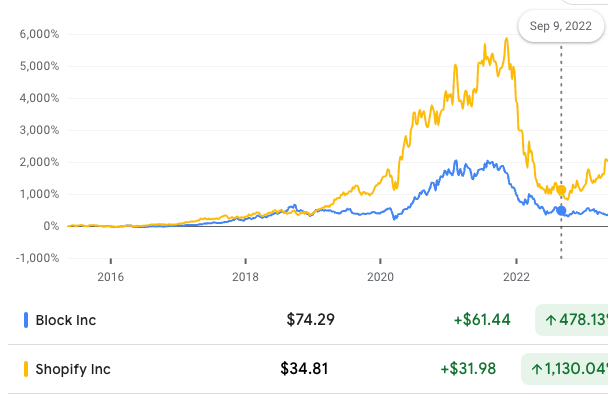
Sequence of events:
1. Pandemic hits in March 2020 and things shut down, stocks go down.
2. For maximum employment, the Fed prints a lot of money (lowers interest rates), basically so things don’t collapse (the federal government separately issues a bunch of PPP loans to businesses). The stock market affects people’s employment / how much companies hire, etc because it affects their cash flow / ability to fund growth.
3. Stocks go way up across the board (ie Mid-2020 to early 2022), especially growth stocks like Square/Block, Shopify, etc. There are other factors here (perhaps a growing tech bubble, investor expectations, etc), but with more money people can bid higher for stocks. Also with growth stocks the cash flow is way in the future, so having low interest rate alternatives in the present (bonds / loaning out money) makes stocks the more attractive investment for banks (EDIT: see a simplified cash flow example of the reverse, where stocks go down as interest rates rise, in section 1 here).
4. Things re-open more and more as the vaccine is broadly adopted and the pandemic starts to ‘end’ around mid to late 2021/early 2022 (covid cases are still up, but death rates are way down, so the vaccine appears to be working well). As a result of the monetary policy during the pandemic still going on (in part), the economy starts heating up, and….
5. Inflation kicks into high gear. It’s higher than its been in decades (8.3% in Aug 2022). There are a lot of causes, supply chain, wages, etc – but regardless of the cause….
6. The Fed has a mandate of stable prices, so the Fed reduces the money supply (i.e. raises interest rates in March 2022). The Fed is aggressively trying to combat out of control inflation, and will very likely continue to do so until prices stabilize, regardless of the impact to growth stocks. They are trying to make sure the global economy isn’t destabilized from out of control dollar inflation, due to money being printed like crazy during the pandemic to keep the economy moving during a global shutdown. They have literally been doing this (using monetary policy / setting interest rates to stabilize prices) for over a century, though obviously their scope expanded significantly during the 2008 recession.
7. Stocks go down, especially growth stocks, and they will likely continue until inflation stabilizes. Side note: Wall Street knows actions by the Fed heavily influences the stock market, so they tend to trade on ‘expected’ changes in rates, which IMO is why stocks start dropping well before March 2022 when inflation continued to stay above the 2% mandate (around mid-2021 it was growing past 5% with no signs of slowing). Then stocks stabilize a bit when the rate ACTUALLY comes in as expected (ie the Fed’s raise wasn’t above or below expected changes). But the Fed doesn’t know when they will stop raising rates (ie to reduce the money supply), because they are waiting on inflation data (eg the CPI) to see the impact of their changes to make a decision. Think of it like the scientific method from the Fed’s perspective: you have a hypothesis/make a prediction, you change something (ie raise rates), then you see what happens to the economy and go from there. They don’t want to over or under react, so they listen to the current situation/data and make a decision.
8. However, in these growth tech companies, layoffs and headcount/hiring freezes start happening, especially around companies that were inflated due to a higher money supply regime (e.g. crypto, growth tech stocks, etc). Because companies made plans during a time when money was ‘super cheap’ and free flowing, but also because when money was cheap, investors invested their money in high growth areas (why not? Money was cheap!). But now that money is getting more ‘expensive’ (ie rates will continue to rise / money supply will continue to fall until inflation stabilizes) folks are moving their money to bonds (with ibonds you can basically lock in a 10% rate right now, guaranteed) and away from stocks.
9. Once inflation stabilizes (eg to ~2%), the Fed can stop increasing rates (the shorter time period the better, so they are being very aggressive to curb inflation / expectations getting out of control), then company leaders, Walls Street, etc can make decisions based on more stable rates AND inflation. But no one knows when that’ll be. So in the meantime, some companies have to make layoffs because right now their situation is unsustainable. It sucks, but it is what it is. Call it bad planning, but really IMO it’s acting in an environment given the information available (ie when money was cheap in 2021, they invested in growing their company…).
To reiterate, this is a vast oversimplification and I’m ignoring Ukraine, economic inequality/ late stage capitalism, etc. I just realized through some conversations that what the Fed does is not common knowledge. Keep in mind with Wall Street: people are greedy, but they are always, consistently greedy – some forces are beyond their control (eg the pandemic).
My main advice is to: (1) recognize the situation we are in, (2) in a boon time, avoid pyramid schemes / scams that go on when money is cheap, people are greedy and willing to take big risks, (3) in a recession, don’t get hung up on the past, focus on the situation as things are now/are likely to be for your specific situation / options.
Side note: no one knows the future, this is just my understanding of the broader present. The Fed has some of the best forecasters in the world (I’m talking hundreds of PhDs from Harvard, Princeton, Stanford, MIT, Chicago, Berkeley, Yale, etc who dedicate their lives to forecasting and working collaboratively), and none of them know the future, they just forecast to better understand the present. For example, suppose you forecast rent, food, oil, goods prices separately, the data is released and then you see where reality lines up with projections, and you then see what levers you have to stabilize prices.
Source: I worked at the Federal reserve in the inflation forecasting group for 2 years. Note: I was a research assistant who supported forecasting and I’m not an expert by any means, this is just my narrative/opinion on what is going on with stocks.
Hope this was helpful! Especially for folks who don’t know what the federal reserve does/have had their stock pay impacted due to things completely out of their control.
Edit: apparently there is a really good John Oliver that came out recently on inflation, so adding the link here.
 Daeus Jorento